
What is root canal treatment?
Root canal treatment — sometimes called endodontic therapy — is the procedure used to save a natural tooth when the pulp (the soft tissue inside the tooth containing nerves and blood vessels) becomes inflamed, infected, or necrotic. Without treatment, the infection can spread through the root into the surrounding bone, cause facial swelling, and lead to loss of the tooth.
Treatment involves accessing the inside of the tooth, carefully removing the diseased pulp, shaping and disinfecting the canal system, and sealing the canals with a biocompatible material. Once treatment is complete, your general dentist places a permanent restoration — usually a crown on back teeth — to protect the tooth long-term. A properly treated and restored tooth can last for decades and is always preferable to extraction and replacement with an implant or bridge.
Why choose a specialist endodontist in Wollongong?
A specialist endodontist has completed three or more years of full-time postgraduate training beyond dental school, focused exclusively on root canal treatment, retreatment, microsurgery, and the diagnosis of complex dental pain. Specialist registration with AHPRA is regulated and can be verified on the public register. The title "specialist endodontist" is legally protected — it cannot be used by general dentists.
Wollongong Endodontics is the only specialist endodontic clinic in Wollongong — until our practice opened, patients across the Illawarra, Shellharbour, Dapto, Kiama and Figtree had to travel to Sydney for specialist endodontic care. Our Wollongong CBD practice at G04/38 Atchison Street offers specialist care backed by the operating microscope, CBCT 3D imaging, digital radiography, and laser-assisted disinfection — a technology combination not matched by any other practice in the Illawarra region.
Our approach at Wollongong Endodontics
Every root canal at Wollongong Endodontics is performed under a dental operating microscope. This gives us up to 25× magnification — enough to identify missed canals, detect cracks, and treat with a level of precision impossible under standard loupes. Where the case warrants, we take a CBCT scan to map the three-dimensional canal anatomy before commencing.
Cleaning and shaping is carried out with heat-treated nickel-titanium files, which follow the natural curve of the canal and preserve more tooth structure than older stainless steel systems. Irrigation is performed with sodium hypochlorite and EDTA, activated using the Fotona SkyPulse Er:YAG laser with SWEEPS technology — a step that delivers a deeper level of disinfection than irrigation alone. Canals are then sealed with bioceramic materials that bond chemically to dentine and provide a durable seal against reinfection.
Laser-assisted root canal — the Fotona SkyPulse advantage
Root canal systems are not simple tubes. They include lateral canals, accessory canals, the apical delta, and millions of dentinal tubules where bacteria persist in biofilm. No hand or rotary file can physically reach these areas. The Fotona SkyPulse Er:YAG 2940nm laser generates photoacoustic shockwaves inside the irrigant itself — driving sodium hypochlorite deep into lateral anatomy and disrupting biofilm mechanically and chemically. Wollongong Endodontics is the only specialist endodontic practice offering laser-assisted root canal treatment in the Illawarra.
What to expect at your appointment
Your first visit is typically a consultation and assessment, during which we review your symptoms, take radiographs (and a CBCT scan if needed), and confirm the diagnosis. If treatment is agreed, we provide a written fixed-fee quote before treatment begins.
At the treatment visit, the tooth is anaesthetised with local anaesthetic. A small rubber dam is placed over the tooth to keep the working area clean and isolated. Treatment typically takes 60–90 minutes. You will hear some water spray and feel pressure, but you should not feel pain — if you do, we simply top up the anaesthetic. Most patients are surprised by how comfortable the experience is, especially compared with what they had been told to expect.
If you have significant dental anxiety, both oral sedation and intravenous sedation are available at our Wollongong practice. IV sedation is administered by a licensed practitioner and means you will have little to no memory of the procedure.
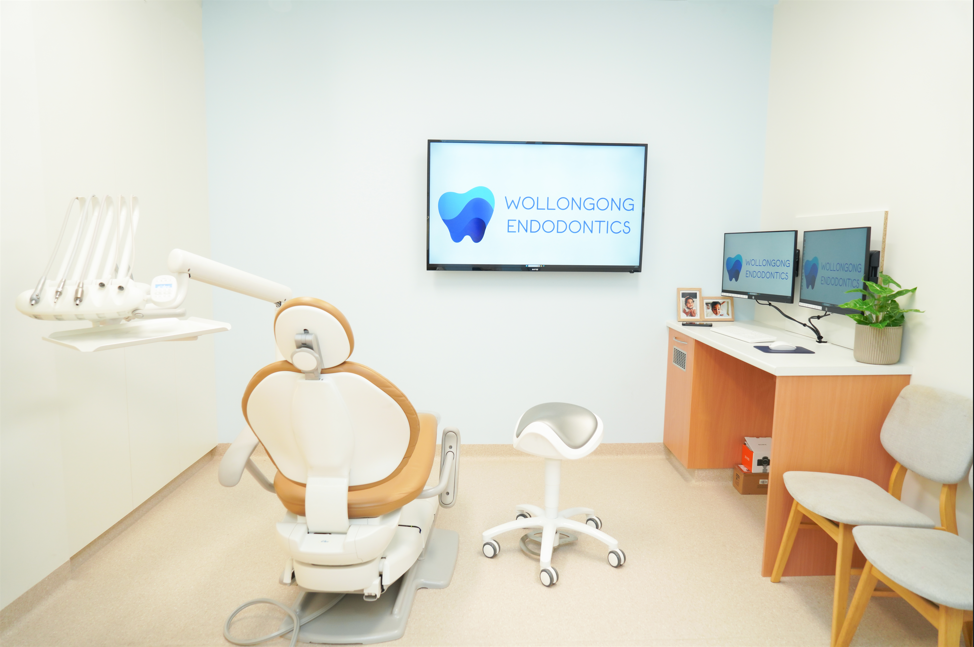
After your root canal treatment
Mild tenderness around the tooth for a few days is normal and usually managed with over-the-counter analgesia such as ibuprofen or paracetamol. Most patients return to work the same or next day. We will let your referring dentist know the treatment is complete on the same day, including microscope photographs and a clear recommendation for the final restoration.
You will see your general dentist within four weeks for the permanent restoration — usually a crown on back teeth. A well-treated and well-restored root canal tooth can last for decades; many last a lifetime.
Emergency in pain? We hold same-day emergency appointments at our Wollongong practice for patients in acute pain. Referring dentists can call (02) 4208 0155 directly, or patients can contact us for an urgent booking.
Referring your patient for root canal treatment in Wollongong
Our online referral form allows you to submit patient details, select the tooth from the full FDI chart, note the clinical indication, and upload digital radiographs or photographs. We aim to contact your patient within 24 hours, and you will receive a same-day electronic report with microscope photographs once treatment is complete. For complex cases, a specialist is always available to discuss over the phone before you refer.
Refer a Patient Online Why Refer to Us
Frequently Asked Questions
Modern specialist root canal treatment is performed under local anaesthesia and is typically no more uncomfortable than having a filling placed. Most patients report feeling pressure or vibration rather than pain. For anxious patients, both oral and IV sedation are available at our Wollongong practice.
Most root canal appointments take 60–90 minutes. Straightforward cases can often be completed in a single visit; more complex cases, calcified canals, or teeth with significant infection may require two visits approximately two weeks apart.
Most cases are completed in one or two appointments. The decision is made after we examine the tooth and review any 3D imaging at the initial consultation. You will receive a clear treatment plan and written quote before treatment commences.
For most molars and premolars, yes. Once the nerve has been removed, the tooth is more brittle and a crown protects it from fracture. Anterior teeth without large existing restorations may not require a crown. Your general dentist will place the final restoration after we complete the root canal, and we will make a specific recommendation in our report.
Specialist root canal treatment has a published success rate of 85–95% over long-term follow-up. Success depends on the initial condition of the tooth, whether infection is present, the complexity of the canal anatomy, and the quality of the final restoration. Laser-assisted disinfection can improve outcomes in cases where bacterial persistence is a concern.
Laser-assisted treatment uses the Fotona SkyPulse Er:YAG laser with SWEEPS technology to drive disinfectant deep into lateral canals and dentinal tubules that instruments cannot reach. This produces a more thorough clean and a lower risk of reinfection. The laser does not replace traditional instruments — it enhances the disinfection phase. Read more about laser root canal treatment →
Yes. Wollongong Endodontics is the only specialist endodontic clinic in Wollongong. Our AHPRA registered specialists, Dr Deepak Chellappa and Dr Sara Namjou, provide specialist root canal treatment, retreatment, apical surgery and dental trauma management from our Wollongong CBD practice at G04/38 Atchison Street. Patients from the Illawarra, Shellharbour, Dapto, Kiama and Figtree no longer need to travel to Sydney.
Use our online referral form. You can attach radiographs and clinical notes directly through the form. For urgent cases, call Wollongong on (02) 4208 0155 — we hold same-day emergency appointment times for patients in acute pain.